
3D Printing Assignment - Deities of Hinduism
- Mar 26, 2017
- 11 min read
Level: Grade 11 Open/Mixed
Subject: World Religions
Duration of Lecture: 75 Minutes
Teacher: Miss Dubé
Description (“crux” of the lesson, where and how does it fit into the course/curriculum)
Throughout today’s lesson students will explore some of the deities within the Hindu tradition. Particular focus will be given to the Hindu Triad which consists of the gods Brahma, Vishnu, and Shiva. The concept of avatars will also be explored. By the end of this lesson students will be expected to know key points of the main Hindu gods and be able to apply that knowledge as they complete the second assignment of this unit: “Invent Another God/Goddess.”
Expectations (Ontario Religious Studies Curriculum Document)
Scripture
Demonstrate an understanding of revelation in the world’s major religious traditions
Show respect for the sacred writings of the world’s major religions
Profession of faith
Respect the various expressions of the sacred as found in the world’s major religious traditions
Examine the human search for meaning and purpose within contemporary culture
Prayer and Sacramental Life
Know and respect the religious symbols in the world’s major religious traditions
Demonstrate a knowledge of religious prayer and worship as a human response to the presence of sacred reality
Explore the connection between religious worship and art
Resources (Equipment and Material)
Smart Board/Computer Access
Pen/Pencil
Handouts (Assignment Sheet)
Teaching Strategies
Individual Learning
Cooperative Learning
Student Groupings
Independent Work
Whole Class
Specific Content
Motivation (grab and focus student attention) _5min._
Before introducing students to some of the more popular/influential gods and goddesses from the Hindu tradition, students will be asked the following discussion questions:
How do Christians view God? What do they believe about God?
How do Hindus explain the idea of God?
*These discussion questions will make students think back to what we have already explored throughout this uint (particularly information regarding Brahman) as well as serve as an introduction to how Hindus explain the idea of God. Through this class discussion students will be able to note the differences between the Christian and Hindu God/god(desse)s and note the ideas that Hindus have about their gods (deities).
Recap (activate and diagnose prior knowledge) 12min._
As a link between the discussion question and the information that will be explored throughout the remainder of this lesson, students will be provided with the following notes regarding the Hindu understanding of God:
Brahman is the Hindu representation of God
Brahman is the soul of the universe from which all existing things arise, and into which they all return
The essence of Brahman is divine, invisible, unlimited, and indescribable.
Brahman is the absolute god of Hinduism and, while he may be one being or ‘force’ that runs through the universe, he has many different roles and sides to his personality
Teacher’s Note: We can understand god, or Brahman, through different forms, dimensions, and personalities. —
Hindus reconcile each of these personalities, each of these different deities however, and believe in
the notion that “god is one” (“Bhagwan Ek Hai”).
These different sides of Brahman make up the Hindu gods — Brahman is one god with many forms
Students will be shown the following video in order to better understand why Hinduism chooses to incorporate a pantheon of gods and goddesses within their religion as opposed to merely one, all mighty, God:
Many gods, one logic — https://www.youtube.com/watch?v=1KWM7P1K1mU
Discussion Questions
Students will be asked the following questions in order to help them more seamlessly conceive the idea of one ultimate being with multiple forms:
Have you ever felt some days that you are a different person?
Do you change your behaviour with different people?
Do you think that one person can sometimes have different personalities?
As a means of visually explaining the results of the class discussion and the idea of one ultimate being with multiple forms, students will be provided with the following metaphor and explanation:
Flower Metaphor — (Pretend for a moment that this flower is you, that it represents everything that you are.) — While some petals represents who you are to different people (son/daughter, friend, pupil, etc.) other petals represent your different emotions (happy, sad, excited, etc.). — Even though you are only one person, you are also a compilation of a bunch of different things. (We can understand Brahman in the same way.)
Body (give and/or demonstrate necessary information) _31min._
Students will take down the following notes for future reference on some of the main gods and goddesses within Hinduism:
Brahma
First member of the Hindu Triad (Trinity)
The creator of the universe
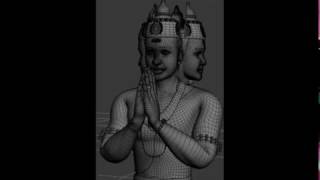
Often shown with four faces looking N S E W to show that he is all-seeing, all-knowing
Vishnu
Second member of the Hindu Triad (Trinity)
Hindus believe Vishnu descends to the world from time to time in human form to maintain the order and harmony of the universe (which is periodically created by Brahma and periodically destroyed by Shiva to prepare for the next creation)
Teacher’s Note: The word “periodically” here refers to the Hindu belief that time is cyclical; everything
in the universe (except for Brahman) is created, maintained for a certain amount of
time, and then destroyed in order to be renewed again.
Vishnu is the ‘pervader’ — the divine essence that pervades (that is perceived in every part of) the universe
Vishnu is worshiped in many forms and in several avatars
“Avatar” means “decent” and refers to the appearance or incarnation of a deity on earth
Teacher’s Note: Avatars of a deity are typically personified as a revered guru or human being — One
of Vishnu’s avatars is even thought to have been the Buddha!
Shiva
Third member of the Triad (Trinity)
Shiva is both the destroyer and the redeemer
Teacher’s Note: Shiva is tasked with destroying the universe in order to prepare for its renewal at the
end of each cycle of time.
Dangerous, destructive and lethal, yet he is joyful and a creative force
Shiva’s destructive power is regenerative: it is necessary step that makes renewal possible
Many people believe the ultimate truth is experienced through Shiva because you must look at evil as well as good — pain and suffering as well as life and growth
“Hindu Triad” (see image bellow)
The three main forms of Brahman consist of the gods Brahma, Vishnu, and Shiva. — Together, these three gods represent the Hindu Triad, symbolizing the cycle of existence.
Teacher’s Note: This concept is known as the Trimurti (Tri = three, Murti = image)
Krishna
Incarnation of Vishnu
Identified as the teacher of the Bhagavad Gita (sacred scripture)
Promised humanity that he would manifest himself and descend to earth whenever dharma (principles of cosmic order) declines
Considered to be the god of love and joy
Ganesha
Regarded as the lord of intellect, Ganesha is the Deity of wisdom, prudence, and learning
Removes people’s obstacles and difficulties by granting wisdom and strength
Ganesha is often shown with a mouse or rat as a symbol of the obstacles Ganesha overcomes
Also considered to be the god of good luck
Teacher’s Note: All of the objects that the deities are holding, or the symbols represented on their
hands, are significant, they are not there just for the sake of being there.
Parvati
One of the three female forms of Shiva’s partner
Goddess of fertility, love and devotion, as well as divine strength and power
Mother of Ganesha
Parvati is the gentle and nurturing aspect of the Hindu goddess Sati
Sati is/was Shiva’s wife
Teacher’s Note: Parvati is a reincarnation of Sati, the daughter of the god Daksha. The legend says that Daksha didn’t approve of Sati's marriage to Shiva and went so far as to hold a special sacrificial ceremony to all the
gods except Shiva. Outraged by this slight, Sati threw herself on the sacrificial fire and died. Sati was
eventually reincarnated as Parvati in her next life and remarried Shiva.
Durga
One of the three female forms of Shiva’s partner
Warrior goddess who slays demons — Goddess of fear and protection
Durga fights fiercely in order to restore dharma (moral order)
While she is terrifying to her adversaries, Durga is full of compassion and love for her devotees
She has the ability to destroy sins, poverty, famine, and evil habits
Kali
One of the three female forms of Shiva’s partner
Symbolizes destruction and death, time and change
Often associated with sexuality and violence but is also considered to be a strong mother-figure and symbolic of motherly-love
Teacher’s Note: She is often referred to as the “Dark Mother”
Kali is the fierce aspect of the goddess Durga
*Students will be shown the concept map “Sati’s Forms/Reincarnations” in order to visually see what has just been discussed. (See concept map 1 below.)
Lakshmi
Goddess of wealth and prosperity (wealth here symbolizes well being)
Wife of Vishnu
As the consort of Vishnu, Lakshmi plays a role in every incarnation, in every lifetime
Lakshmi possesses knowledge of enjoyment but is not obsessed with material things — She knows about all activities, both spiritual and this worldly
Rama
Avatar of Vishnu
Referred to as the lord of self-control or virtue
Considered to be the embodiment of the perfect man (Maryada Purushottama)
The hero of the Hindu epic called the Ramayana. In it, he is portrayed as an ideal son, brother, husband, and king.
Strict adherent of dharma
Sita
Avatar of Lakshmi
Considered to be an embodiment of perfect womanhood
Wife of Rama
Known for her dedication, self-sacrifice, courage, and purity
*Students will be shown the concept map “Finding Each Other Again” in order to visual see what has just been discussed. (See concept map 2 below.)
Saraswati
Female partner of Brahma
Goddess of creativity and knowledge (wisdom, learning, the arts, and music)
Possesses pure knowledge and uses it with love
Check for understanding (key words or questions) _5min._
Students will be given the following notes to take down for future reference on how Hindus experience god in all forms:
Anthropomorphic — Human Form
Zoomorphic — Animal Form
Nature — Rivers, Trees, Flowers, etc.
Creativity — Art, Dance, Theatre, Sound, etc.
Teacher’s Note: Sound can be interpreted as a mantra—“OM” fro example is the sound expression of the divine.
Guru (“GuruDev”) — People themselves (“guru” = teacher, “dev” = god)
Experiencing God in Everything
God is everywhere and immanent, god is in animals, in trees, rivers, idols, in other human beings, in sound, music, dance…
Pranam is the common greeting of reverential bowing before something, or someone, which recognizes the divinity in others — “I am bowing to the god in you.”
This idea of the Devine being everywhere is why, for Hindus, the practice of Puja, making offerings to an idol (a murti — an incarnation of the Devine), is not reducing god to form because, well, god is everywhere, including within the idol!
Consolidation (application or practice of knowledge: activities, exercises, games) _21min._
Students will be introduced to their second assignment for this unit: Invent Another God/Goddess.
Now that students have explored some of the different gods and goddesses of Hinduism, they will be tasked to use their knew found knowledge in order to create another god or goddess of their own. (See assignment sheet bellow.)
*The remaining time of this lesson will be given to students to begin working on their second assignment.
Closure (recap key concepts, look ahead) _1min._
A Look Forward
Students will be advised that the following lesson of this unit will be dedicated to the exploration of the three different paths of salvation within Hinduism. Due to the amount of information that will be present throughout the following lesson, students will also have the opportunity to continue working on their second assignment.
Adaptations
Student with Visual Impairment
Provide student with printed copy of lesson slides so that they will not have to strain in order to see the notes. Doing this will allow the student to concentrate on any extra information that will be provided as well as participate during class discussions.
Regarding the Assignment
As an alternative to creating a three dimensional printing of their deity, students may choose to draw their deity, making sure to represent both the front and back of their creation. Because the assignment calls for the use of three dimensional printing technology, students who do not three dimensionally print their deity, will be tasked with creating an artifact that represents their deity and three dimensionally printing this artifact instead. Note that they artifact can be very basic in its design. The goal of this alternative choice in regards to the assignment is meant to take away some of the stress students may feel in regards to creating a complex being using technology that they may not be familiar with.
Lesson review (how did it go? changes?)
God Daksha (Sati’s father) — Extra information concerning the story of Sati’s death
Teacher's Note: When Sati threw herself on the sacrificial fires in outrage at what her father had done, Shiva reacted to this tragedy by creating two demons who wreaked havoc on the ceremony and beheaded Daksha. The other gods appealed to Shiva to end the violence and, complying, he brought Daksha back to life but with the head of a ram (or goat).
______________________________________
Invent Another God/Goddess
Many Hindu gods and goddesses have special attributes such as extra arms, heads, eyes, or body parts from different animals. Often, they are pictured holding symbolic objects in their hands. These objects represent their powers or abilities.
Now that we have explored some of the different gods and goddesses of Hinduism, you are going to use what you know about their characteristics in order to create another god or goddess of your own.
The final result that you will be submitting must include:
A rationale explaining/describing your god or goddess and
A visual representation of your deity
For the visual representation of your assignment, you will be tasked with designing and printing a three dimensional idol. You will be given class time to establish what you want to create as well as time to complete the design of your deity. When you are ready to print, simply come see me with your design and I will assist you in the printing process.
You must include the following information about your god or goddess within your rationale:
Their name
Provide them with specific characteristics of their own
List their relations (to other deities, gurus, etc.), how they are related, and why
Assign your deity a power
Note: Remember that, since your visual representation is three dimensional, you will have to think about the whole of your deity. Think about what you want the back or sides of your character will look like as well as what they look like from the front.
*When you’re thinking about what you want their characteristics to be, think about what they might be holding and what that represents. (Ex.: Brahma holds a lotus flower because it symbolizes beauty and rebirth.)
Assignment Rubric
Knowledge/Understanding
Demonstrates knowledge/understanding of various elements
Level 1: Few elements are discussed with limited understanding
Level 2: Some elements are discussed with some understanding
Level 3: Most elements are discussed with a clear understanding
Level 4: All elements are discussed in detail with a thorough understanding
Thinking
Identifies characteristics and relations
Level 1: Few characteristics and no relations are identified
Level 2: Some characteristics and one relation is identified
Level 3: Many characteristics and multiple relations are identified
Level 4: Many unique characteristics and insightful relations are identified
Application
Descriptive overview of deity (content and detail)
Level 1: Content was basic and incomplete, it did not allow the reader to fully understand the deity
Level 2: Content was somewhat complete but lacked detail
Level 3: Content was complete, it was sufficiently descriptive and well detailed
Level 4: Content was complete, very descriptive and excellently detailed
Communication
Clarity of rationale (proper grammar and spelling)
Level 1: Limited clarity of writing with many errors
Level 2: Some clarity of writing with some errors
Level 3: Clearly written with few errors
Level 4: Clearly written with a sophisticated vocabulary
______________________________________
Screen Cast Script
These slides represent the information that will be explored throughout the lesson that will present students with the necessary information they will require in order to complete their Deities of Hinduism assignment.
The assignment will assess students' knowledge and understanding of the characteristics surrounding Hindu deities. But the incorporation of three dimensional printing will ask students to approach the creative process in a new and innovative way.
The use of this technology will force students to think about the whole being, or about each facet of their creation. Let us look at Brahma for example, and how he might more accurately be represented if we were to use three diminutional printing technology. — Brahma is often depicted with four faces looking North, South, East, and West to show that he is all-seeing. Three dimensional printing would allow for Brahma to be presented in such a way that each of his faces could be properly developed.
Students may choose instead to draw their deity, making sure to represent both the front and back of their creation. But, students who do not three dimensionally print their deity, will be tasked with creating an artifact that represents their deity and three dimensionally printing this artifact instead.
The assignment parameters will allow students to think critically, in a new and innovative way, about what they are creating.




Comments